

About JFBAJournal of Fintech and Business Analysis (JFBA) is an open-access, peer-reviewed irregular journal hosted by Beijing Computer Federation and published by EWA Publishing. JFBA serves as a cutting-edge standardized academic platform tracking digital economy evolution, covering normative research on digital growth theory, digital industry evaluation, industrial digital transformation and digital governance, highlighting cross-disciplinary integration, global economic exchange and digital industrial empowerment value alongside core practical application and economic value, and shares frontier analysis models and industrial practice cases for fintech analysts, digital transformation consultants and economics university researchers to translate digital economic research value into industrial practice results. For more details of the JFBA scope, please refer to the Aim & Scope page. For more information about the journal, please refer to the FAQ page or contact info@ewapublishing.org. |
| Aims & scope of JFBA are: ·Digital Economy ·Financial Technology ·Business Analytics |
Article processing charge
A one-time Article Processing Charge (APC) of 450 USD (US Dollars) applies to papers accepted after peer review. excluding taxes.
Open access policy
This is an open access journal which means that all content is freely available without charge to the user or his/her institution. (CC BY 4.0 license).
Your rights
These licenses afford authors copyright while enabling the public to reuse and adapt the content.
Peer-review process
Our blind and multi-reviewer process ensures that all articles are rigorously evaluated based on their intellectual merit and contribution to the field.
Editors View full editorial board

London, UK
canh.dang@kcl.ac.uk

Beijing, China
qingshuiruyuew@gmail.com

London, UK
an.nguyen@kcl.ac.uk

Birmingham, UK
Chinny.Nzekwe-Excel@bcu.ac.uk
Latest articles View all articles
Based on an analysis of the research background, objectives, and significance, this paper employs a variety of research methods to examine the manifestations of credit risk prevention and control in China's banking industry. It further identifies the underlying causes of these risks from four perspectives: the external economic environment, internal banking operations, borrowers, and institutional factors. In response to the emerging trends and challenges facing bank lending, the paper proposes a series of countermeasures, including strengthening risk awareness, enhancing risk management, improving early warning systems, making effective use of credit risk mitigation instruments, implementing sound credit authorization policies, optimizing corporate governance structures, making appropriate dynamic adjustments to credit limits, and reinforcing governance functions, with the aim of improving credit risk prevention and control across China's banking sector.

 View pdf


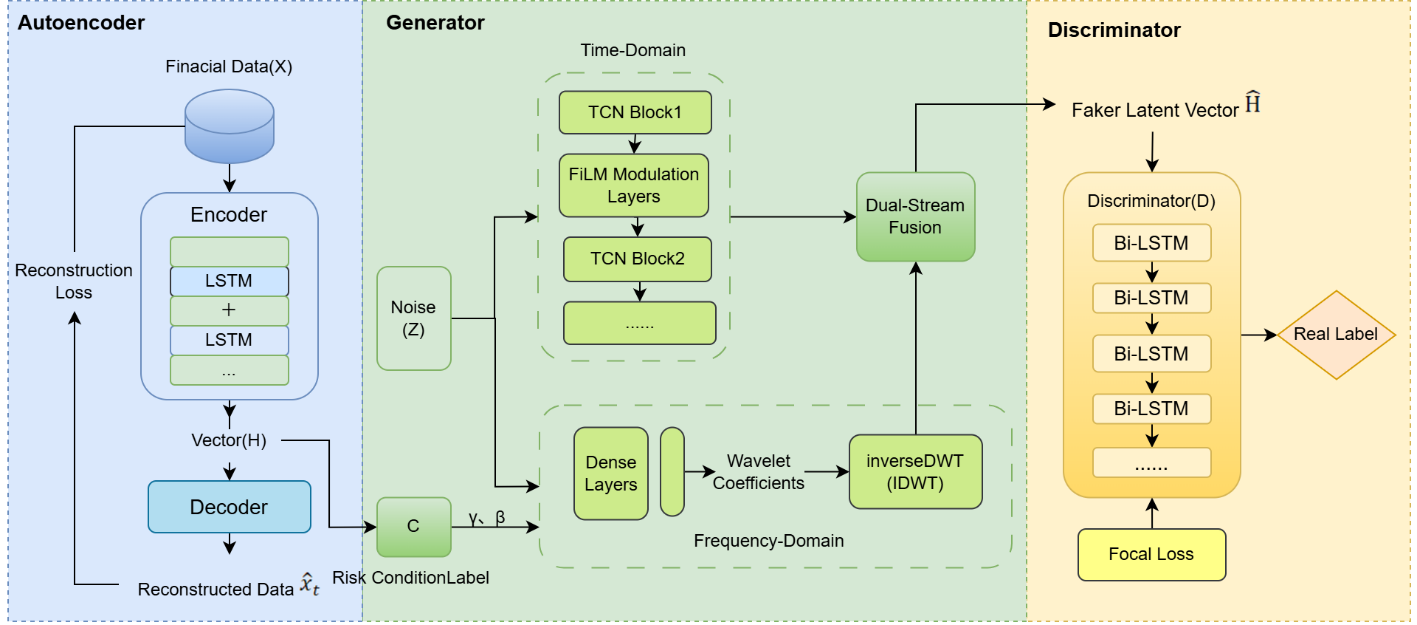
Owing to the low occurrence frequencies of extreme financial risk events, risk prediction models are prone to being dominated by the majority of the normal samples encountered during the pretraining process when using financial risk data. This weakens the ability to effectively learn abnormal characteristics and thus reduces the sensitivity and stability of the developed predictive model. To overcome these limitations, a data class-balancing model, Financial Wasserstein Generative Adversarial Network with Gradient Penalty (FinWGAN-GP), is constructed on the basis of the Wasserstein Generative Adversarial Network with Gradient Penalty (WGAN-GP) framework. Experimental results reveal that the FinWGAN-GP model achieves high-fidelity generation and expansion for high-risk samples, and a balanced dataset is conducive to improving the training effect of the early warning model. Through the integration of multisource heterogeneous data and Artificial Intelligence (AI) methods, the proposed model can identify potential financial risks earlier and more accurately, helping enhance the forward-looking and scientific nature of financial regulation.
View pdf
Generation Alpha, the first cohort to grow up with artificial intelligence, is expected to become the largest consumer segment in history. However, academic research on their cognitive characteristics and consumption behaviour remains limited. This study aims to construct a multi‑dimensional cognitive profile of Generation Alpha and to examine how this profile drives retail business model innovation. A structured questionnaire survey was conducted with 316 parents of Generation Alpha children in China, covering four cognitive dimensions: behavioural patterns, product preferences, social concerns, and brand acceptance. Descriptive statistics, correlation analysis, and multiple regression analysis were used to analyse the data. The results show that Generation Alpha children exhibit moderate levels across all four cognitive dimensions. Product preference emerged as the strongest predictor of brand acceptance (β = 0.318, p < 0.001), followed by social concern (β = 0.218) and behavioural profile (β = 0.213). The model explained 31.8% of the variance in brand acceptance. These findings provide empirical support for three retail innovation pathways: product creativity enhancement, channel transformation, and communication upgrading. The study offers both theoretical contributions to generational consumer behaviour research and practical guidance for retailers seeking to engage Generation Alpha.
View pdf
From ancient bronze coinage to modern blockchain-based tokens, the form of money has undergone a clearly identifiable process of evolution. Yet its fundamental dilemma has remained unchanged: how can a symbol devoid of intrinsic value—the "name"—be made to assume the function of measuring real social wealth—the "substance"? At first glance, the "treasure currency system" introduced by Wang Mang in the late Western Han dynasty appears entirely unrelated to contemporary stablecoins. In essence, however, both confront the same predicament—the separation of name and substance. This study therefore presents a perceptive and logically rigorous comparison of their respective credit mechanisms. Wang Mang's monetary reform ultimately collapsed under the issuance of "nominal values" driven by state power, whereas the central challenge for stablecoins lies in how to anchor their nominal value to credible "substance" within a decentralized framework. From this perspective, the paper naturally arrives at the conclusion that only when name and substance are unified through a credible credit anchor can monetary stability be achieved. The historical experience thus provides a valuable point of reference not only for the study of ancient monetary reforms, but also for contemporary discussions on the regulation of digital currencies, the internationalization of the Renminbi, and the ongoing process of monetary digitalization.
View pdf
Volumes View all volumes
2026
Volume 3July 2026
Find articlesVolume 3October 2026
Find articlesVolume 3March 2026
Find articles2025
Volume 2December 2025
Find articlesVolume 2June 2025
Find articlesVolume 2September 2025
Find articlesAnnouncements View all announcements
Journal of Fintech and Business Analysis
We pledge to our journal community:
We're committed: we put diversity and inclusion at the heart of our activities...
Journal of Fintech and Business Analysis
The statements, opinions and data contained in the journal Journal of Fintech and Business Analysis (JFBA) are solely those of the individual authors and contributors...
Indexing
The published articles will be submitted to following databases below: